7am is a lie-in for Laura Fayet. On most days, she walks in the dark towards the jetty she has always known to step onto her boat by 4:30. Moored opposite hers is the wooden one that belonged to her great-grandparents that is one hundred years old. Their former house stands a few feet away, in view of her own. Her lineage and their footprints can be traced back in the sand of this bay for six generations. She is the seventh to work on Léman.
“I don’t get my eight hours,” she says, with a lighthouse smile. What she gets instead is the sunrise all to herself.
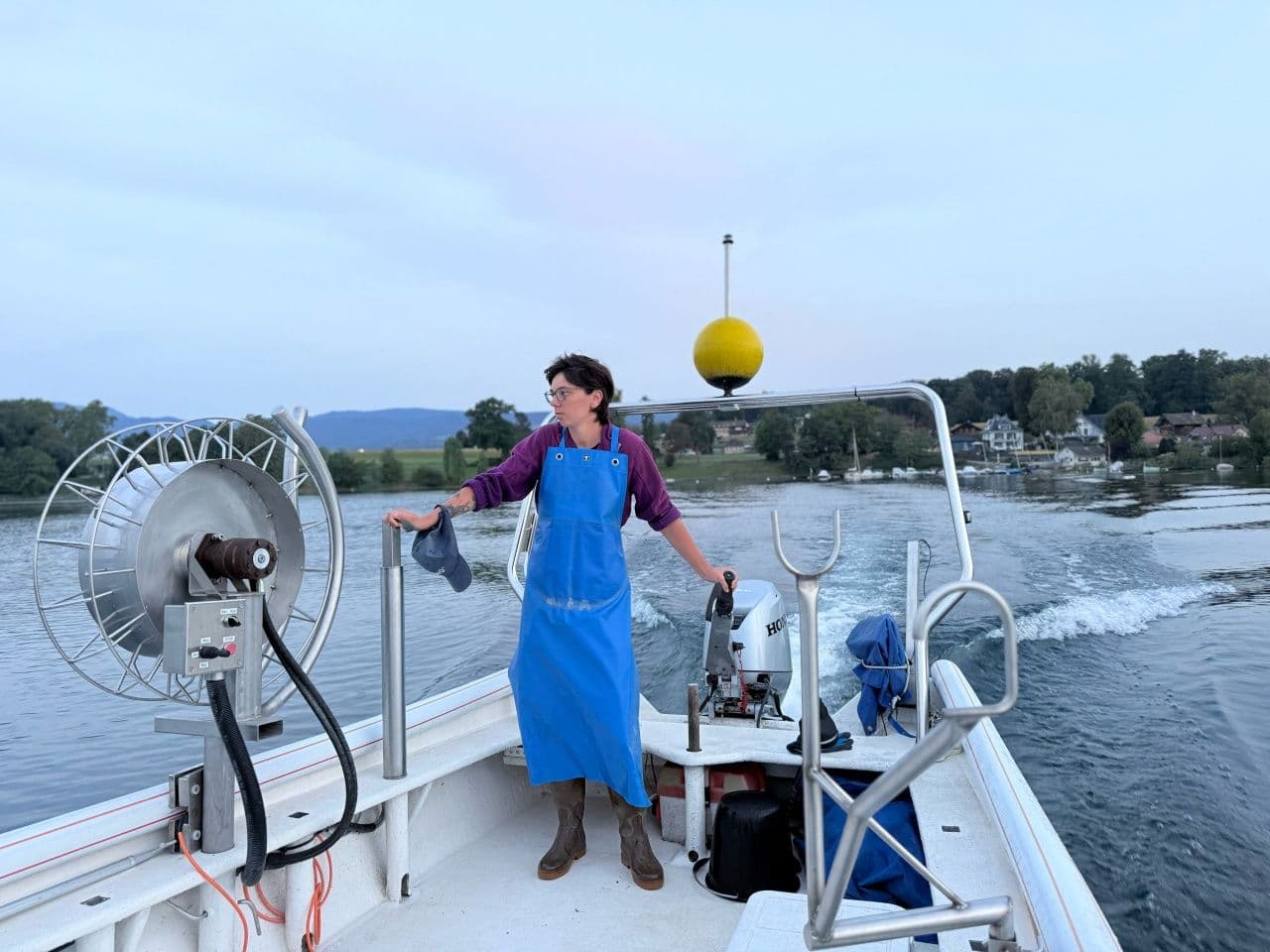
We head out and interrupt the stillness of the water towards three nets she cast the night before. She has placed them in zig zags, not even five minutes from the shoreline. Though she has been doing this since before she could walk, her grandfather embarking her and often a few neighbours with him, this is still her favourite part. The anticipation. The daily potential for surprise when seeing the offerings she has caught. Some days, that can be nothing at all.
“It’s the lake that decides,” she says firmly. The water is only spoken about with reverence.

At 24, she is the youngest and one-of-three women to have a fishing licence on the Swiss side of Léman. It was not a choice, but a calling. Though inseparable from her upbringing, through his own difficulties, her grandfather always encouraged a second career. Fishing professionally was meant to be for later until a permit, of which there are a limited number, became available. She passed her apprenticeship in 2023 and continues to attend university in Geneva part time. The study of nature conservation, which she switched to from biology, is something she sees as crucial to better understanding her trade.
This is a different routine to the fishermen you would expect on the lake, who according to Laura average between the age of 55 and 85. Some even complained that women should not be allowed to obtain a licence as the work is too difficult. There is certainly labour involved, but it is confronted without fuss. Under the ascent of a timid sun, she moves rhythmically to pull up the first net by hand. Her Paléo cap is set tight, worn as this summer’s badge of honour. Water drips off her apron. She starts to bring up reams and reams of perches. Dozens. An abundance. More than the lake illiterate would ever expect or imagine.
“It’s a good catch,” she affirms, before giving us the Latin name of another type of fish in her net. Rutilus rutilus. Or the common roach. She points out the two species who made it onto the boat that are not native to Léman. A California crayfish which is kept. The quagga mussels spewing black sediment get duly flicked back into the water. Laura places the net down before covering it with scoops of ice. There’s already another boat heading back to the bay. Her father, who raises his hand in salutation. As colleagues, they’ll compare their catch at the fishery with healthy competition before it gets sold on.

Laura takes care with the details when giving explanations on the health of the lake and its different species. She’s patient with our white-collar questions. The ice is to keep the fish fresh. The biggest thing she’s ever caught is a 12.8 kg pike, almost the height of her grandmother. Yes, she sees things that she does not recognise all of the time. The other month she saw a larvae attached to her net that she could not identify. Every working day, she is on guard. She looks closely and takes note.
“Being a fisherman isn’t just about catching fish and selling them. It’s also about observing them. We act as sentries. We are the watchmen of the lake.”
It’s fishermen, in fact, who alert authorities to the first signs of anything strange. A colleague of hers raised the alarm 14 years ago about the invasive quagga mussels, which have had a major, widely reported impact on Léman. They spread like wildfire, filter out vital nutrients and cling onto all surfaces, including Laura’s nets just overnight. The lake is forced to adapt, albeit slowly. Laura and her father adapt to the lake in response. Like encouraging their clients to eat catfish, another invasive species that is currently thriving. Laura posts recipes on their Instagram page and it’s now a regular catch, with demand from restaurants and private clients on the increase.
“Just like nature, we continuously adapt and change,” she says, “we play a part in this adaptation too.”

What she means is ensuring there is balance in species by changing their methods according to population levels. Fishing in the Léman is heavily regulated, with specific mesh sizes to ensure fish have reproduced a certain number of times. There are designated months of the year where species must be left alone entirely. Laura puts her studies into practice by collaborating with scientists, acting as a bridge between their projects and what she observes. She provides stomach samples to assess plankton. She cuts off heads and scales for research. She also works on repopulation projects, collecting eggs for fish farms and seeing how marked tadpoles appear in her nets years later, determining how these efforts should continue.
Back on the jetty, she lifts three crowded nets onto a metal wheelbarrow. She is still beaming at a time when most are not even feeling the effects of their first coffee. Her good catch is heavy. The reason why she has to do regular strength training for her back is entirely down to the ecosystem she participates in beyond the trade itself. The regulation, the policy and the science. For this way of life and this way of eating, from our very own waters, does go back hundreds of years and remains the most sustainable.
Bringing fish out of the water is just one stage of the process. Laura begins to disentangle each perch into buckets before they will get gutted and prepared. She stands opposite her father as he does the same. This is their morning routine and his pride is palpable. Usually, fishing gets inherited on the male side of the family. Her grandmother gets seasick and has only been on a boat twice. Her mother takes it one step further by not liking fish at all. Instead, they help out with the family shop, the administration and the trade union they lead. Laura is the exception.

Her grandad seemed to know this already. He aptly named the boat his parents built in 1926 ‘Capitaine Laura’. She can see the inscription every day. Though he is no longer here, his influence appears to be etched into Laura’s choices as permanently as the tattoos on her forearm. He has passed down more than just a family tradition. What she carries, and is committed to taking forward, is a connection to our environment that many of us have forgotten. That as humans, we think we have evolved from.
“Aside from the boat's engine and the motor sometimes used to lift the nets, there has been very little technological progress,” Laura affirms, “the job remains the same.”

The lake, however, doesn’t. There is always anticipation before Laura gets to her nets because it might always offer something different. It will certainly look different. Before the majority of us start our mornings, she’ll already be out there keeping watch. Working on the water and working with the water. Staying humble yet devoted to her profession and its legacy.
“For me it’s completely normal, it is what I have always known,” she says.
For anyone else, she is pretty extraordinary.

Laura Fayet and her father Alexandre sell their catch at Pêcherie de la Dullive in Gland. Their contact details, as well as Laura’s educational posts about the lake and their work, can be found on Instagram via @pecherie_de_la_dullive_
This article is part of our Lake Perspective series. Vanessa Tracey also writes a newsletter on Substack. You can read more of her writing here.