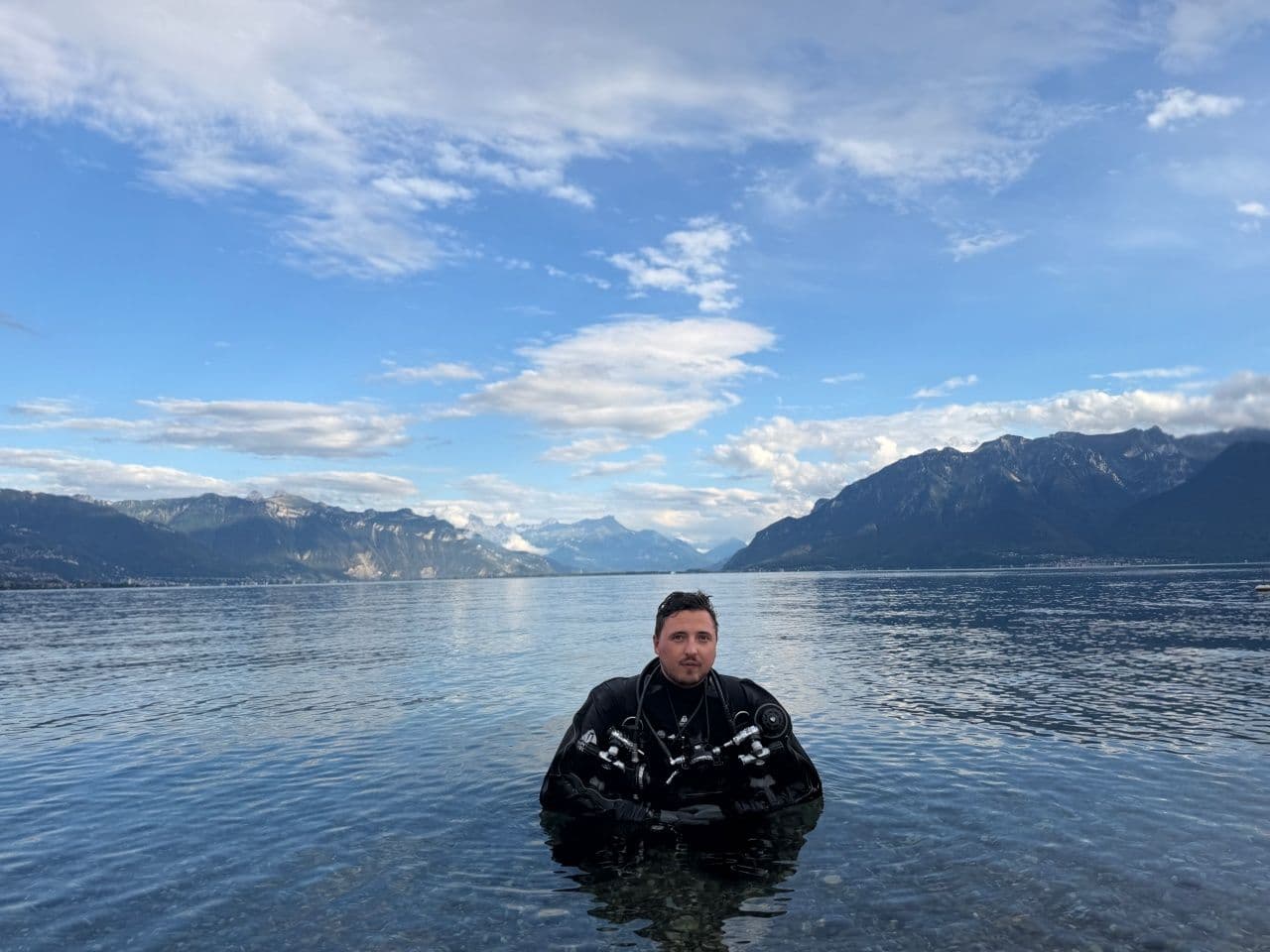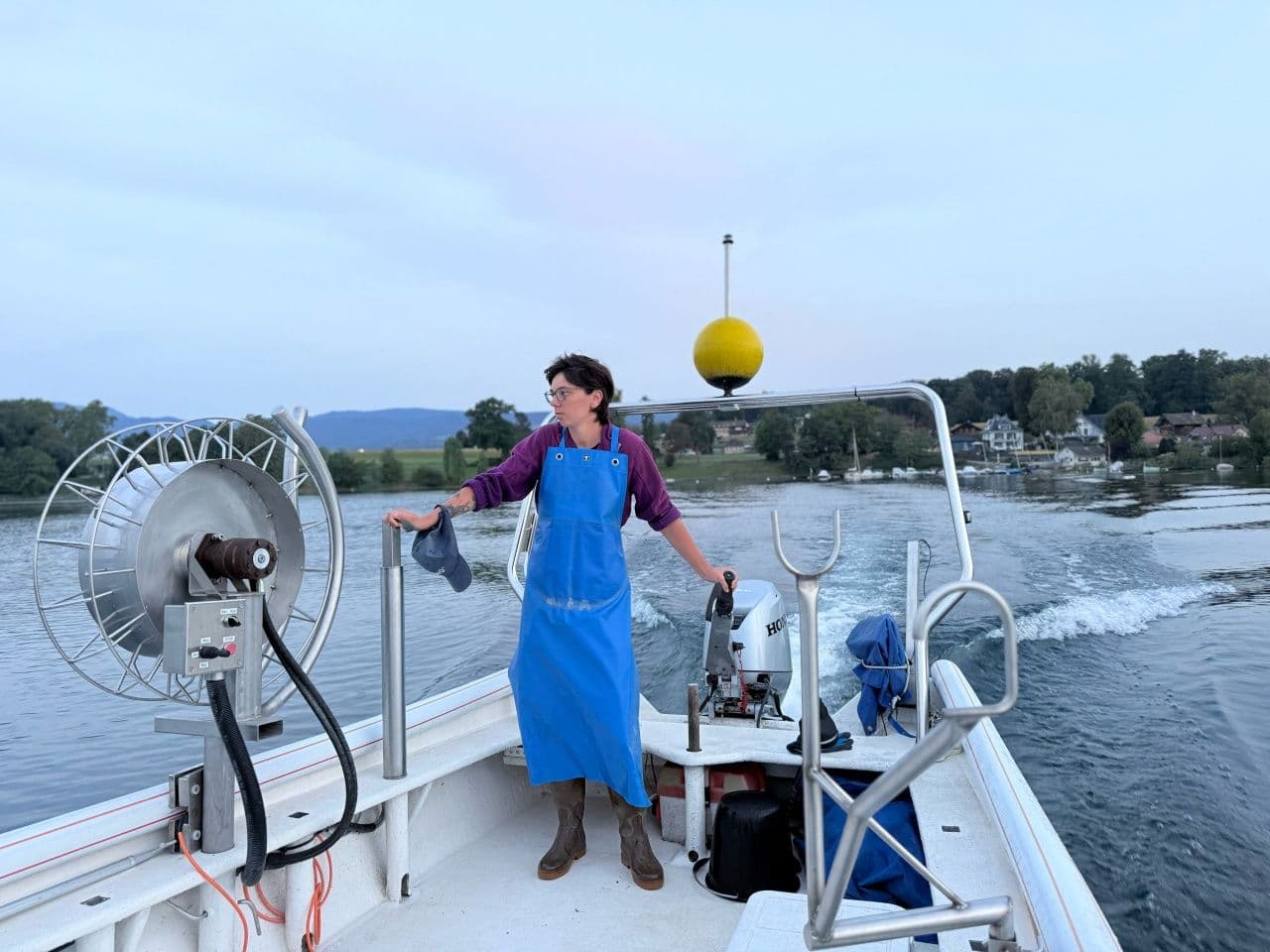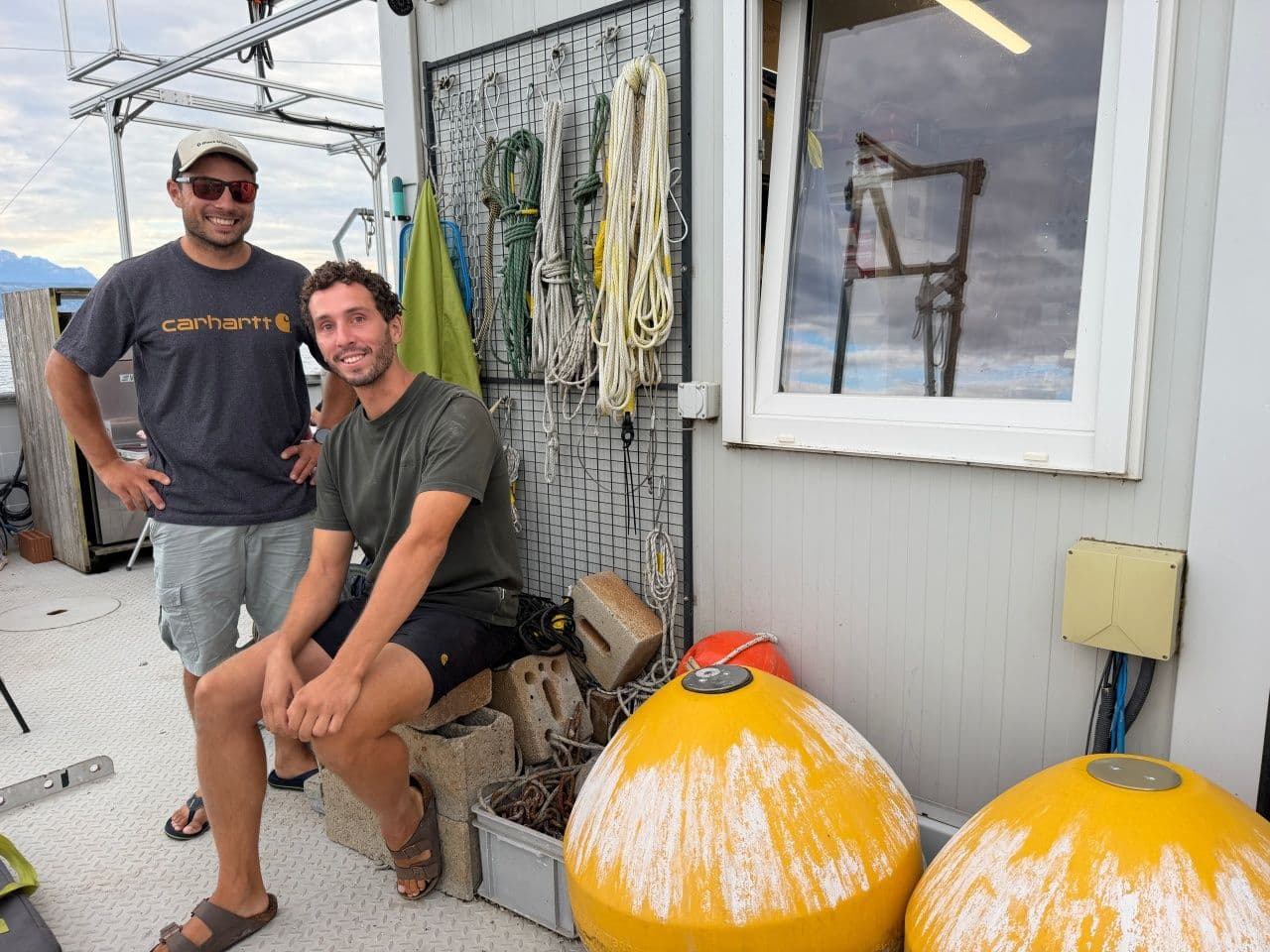
Guillaume Cunillera and Jérémy Keller have a floating office. A 10 by 10 metre pontoon off Pully beach that sparks curiosity from all directions. From the yacht club sailing past. From the locals walking by the harbour, forever wondering what on earth they get up to. From the birds who dare take a peek. Most importantly, from those conducting research on board. As they work alongside, and often against, the elements to facilitate lake surveillance, this is not your typical desk job.
They are Technical Managers for LéXPLORE, the cutting edge Léman laboratory that is purpose built and unique in the world. Not only for its size, but for the capacity it has for scientists to carry out vital lake study, and for its 24/7 data collection, measuring temperatures, currents, pH levels, oxygen levels and light penetration. Jérémy and Guillaume keep everything running, advising on research projects to ensure they’re executed correctly. They also support with the installation and use of high-tech equipment. Basically, they make sure everything stays afloat.

“No two days are ever the same,” Guillaume tells me, “one day we’ll be writing code to develop a programme to read data. The next day we’ll be taking an instrument apart to work on the electronics. The day after we’ll have a problem with perimeter chains, so we’ll put on gloves and lift kilos of disgusting chains covered in quagga mussels. The day after that, there’ll be a storm so we’ll have to rush to rescue an instrument that’s being swept out into the lake. And on the last day of the week, we might head on dry land to write a short report.”
The lab’s compact structure is remarkably deceptive. As we step on to the platform that is occasionally rocked by the water, researchers are scribbling into notebooks and taking samples, preparing to bed down for the night. At regular intervals, they will work through it. LéXPLORE has a protected perimeter of 120 metres and a depth of 110 metres for them to use and leave their instruments undisturbed. The lab’s continuous data collection, which is also open source, provides a running baseline to help contextualise results.

As described by Jérémy; “it’s a singular geographic point but it brings together many different dimensions and a greater understanding of the processes that are happening right beneath our feet.”
The processes being examined, as you’d rightly guess, mainly relate to the environment and the ways in which the lake is changing. Limnology is the official term for lake and freshwater study, but these 100 square metres on Léman serve as a scientific meeting point across disciplines. On board you might find physicists analysing temperatures, turbulence and micro-currents. Chemists measuring microplastic levels. Biologists using sonars to survey fish, or studying invasive species. Even astrophysicists detecting cosmic particles from space, and the flashes of light they produce as they reach the water’s surface.
“We’re in an extremely interesting scientific context which gathers completely different people from all around the world,” Guillaume says with enthusiasm, “It’s rare to have such a multidisciplinary space where people of all backgrounds can talk science.”

It is this variation, both in the management of the lab and the study possibilities it grants, that seems to motivate the pair the most. Guillaume is a French ecologist by background, working in a research unit before being hired in 2020, a year after the platform was anchored. Jérémy is from Neuchâtel and came to LéXPLORE taking zooplankton samples as part of his masters in aquatic science. He’s since been working on it full time, joining Guillaume two years ago as an EPFL technician. The university is one of five institutions that partnered to bring the lab to life, and in close collaboration, is responsible for the day-to-day.
They are jocular with the scientists and with each other. In fact, teasing seems to be an essential part of the job. We ask them questions between cables, winches, antennae and ropes. We peer into moon pools, two water openings for sample collection, protected and unprotected. They show us the drone that helps recuperate sunken equipment. The photos of the fondue they had. The bird invasion. Jérémy points out to Guillaume a buoy that has been damaged. Guillaume finds a hook they thought was lost. In between, they provide guidance to the researchers who are mostly master’s students. It is constant and immediate problem solving. The platform is powered by solar energy, but primarily by the guys’ dedication.

“Out of all the causes we can fight for on this planet, the environment is the one that appeals to me the most,” Jérémy says. “The lake provides all kinds of services to the population but beyond that, it deserves to be protected and defended.”
There is no denying that the outcomes are bleak. Though the lake’s pollution levels have improved since the swimming restrictions of the 60s and 70s, the impact of our changing climate cannot be understated. One hot topic on the platform is the lack of ‘mixing’ in the lake. A yearly process that brings turnover as top, oxygen-rich layers sink and nutrients are brought to the surface. Because of rising temperatures, this hasn’t happened since 2012 and the depths are oxygen starved. Another study that has come out this month, partly conducted on the platform, showed that Léman’s microplastic levels have been hugely underestimated. We ask them whether they can ever draw positives from the work on the lab and they both grimace.
“Monitoring the lake also enables us to have a better idea of what to expect in the future and to prepare for it more effectively. That doesn’t mean we can save the world, nor necessarily save the lake, but we can at least have a better idea of what’s to come and be confident about its potential,” Jérémy says.

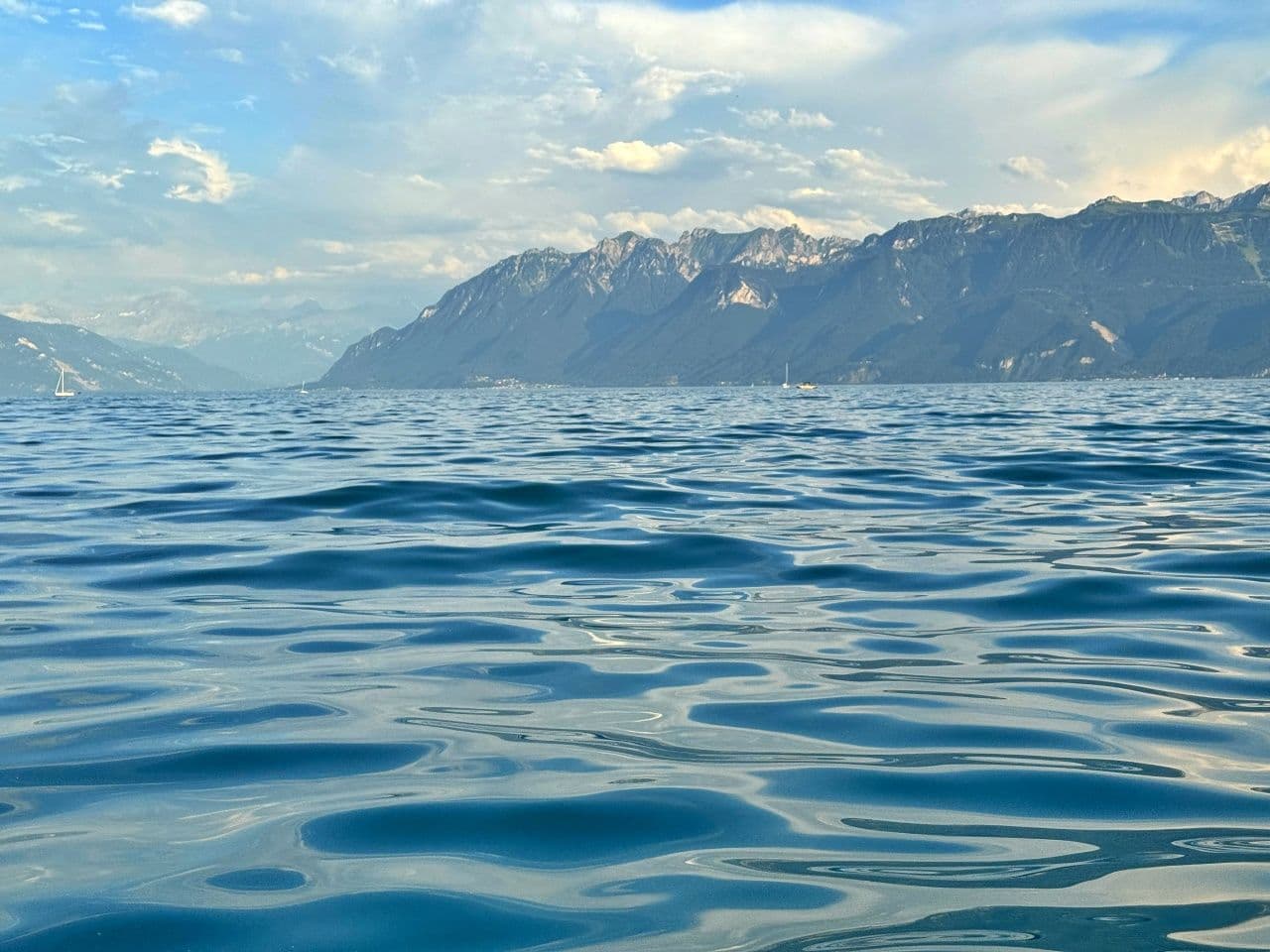
As if to emphasise its flux, the water is dark and choppier than usual. The air, however, is warm. Tonight, the researchers should be able to catch a few winks under the stars. These conditions are pleasant but Jérémy and Guillaume have to be out in all kinds, during all seasons. It can be a battle, working against a body of water that often tries to hinder its own surveillance.
“There’s an energy to the lake that we do not realise,” Guillaume says, “I’m always surprised by the power of nature. The fact that we’re in an environment that’s in constant motion means that everything always ends up breaking. We’re then here to maintain and repair.”
This maintenance is a seemingly endless to-do list to make sure that the science does not stop. When he’s home in the evenings, Guillaume likes to give the cameras a quick check to ensure that everything is running smoothly. That nothing is drifting away.
“We tried to train the seagulls to keep an eye on the platform but it didn’t work,” he jokes.
With 30 ongoing projects to support, it sounds like they’ll be keeping their jobs without delegation. And that the work they do, enabling lake study and providing 360 degree analytics whatever the weather, has never been more essential.

The LéXPLORE platform is a collaborative partnership between five research institutions: EPFL, Eawag, University of Lausanne, University of Geneva and CARRTEL. Its data is uploaded to www.datalakes-eawag.ch.
You can book a public visit to the platform here, or in the meantime, have a 3D look online.
This article is part of our Lake Perspectives series. Vanessa Tracey also writes on Substack. You can read more of her work here.